
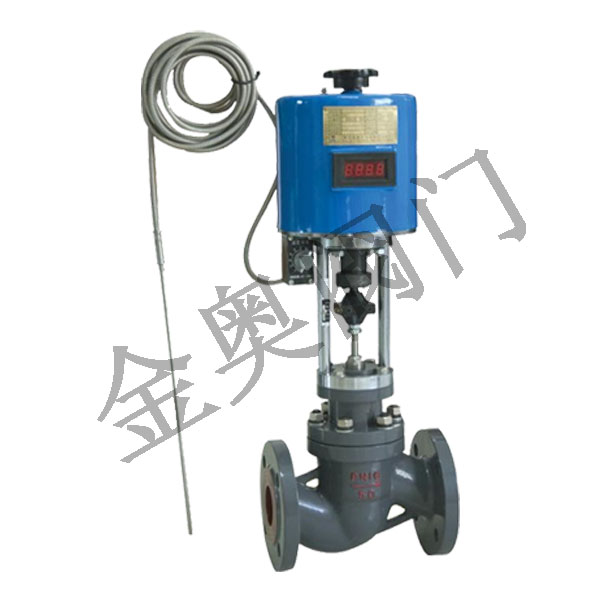
Working principle (cooling type)
The working principle of the self-operated temperature control valve for cooling can refer to the self-operated temperature control valve for heating, but when the spool components open and close under the action of the actuator and spring force, it is the opposite of the temperature shut-off valve, and the valve body passes through the cold medium, which is mainly used for temperature control in the cooling device.
How it works:
After the controlled medium is input into the valve, the pressure in front of the valve P1 is input into the lower membrane chamber through the control pipeline, and the pressure Ps after being throttled by the throttle valve is input into the upper membrane chamber, and the difference between P1 and Ps is △Ps=P1-Ps is called the effective pressure. The thrust generated by P1 acting on the diaphragm and the thrust difference generated by Ps acting on the diaphragm are balanced with the spring reaction force to determine the relative position of the valve spool and the valve seat, thus determining the flow flow flow through the valve. When the flow flow through the valve increases, that is, △Ps increases, and the result is that P1 and Ps act on the lower and upper membrane chambers respectively, so that the valve core moves in the direction of the valve seat, thus changing the circulation area between the valve core and the valve seat, so that the Ps increases, and the increased Ps on the diaphragm plus the spring reaction force and the thrust of P1 acting on the diaphragm produce a balance at the new position to achieve the purpose of controlling the flow. Conversely, the same principle.
Self-operated control valves are used to adjust process parameters such as medium flow, pressure, temperature, and liquid level in the field of industrial automation process control. According to the control signal in the automation system, the valve opening is automatically adjusted, so as to realize the adjustment of medium flow, pressure, temperature and liquid level.