
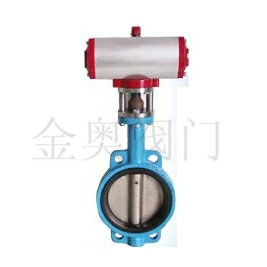
Instructions for use:
ZSCW Pneumatic Butterfly Valve is a rotary type control valve. It has the advantages of small size, light weight, and large rated flow coefficient, and is especially suitable for large diameter, large flow, concentrated turbid slurry or boiler kiln flue gas control.
This series of products has three types: standard, high temperature and sealed. The nominal pressure rating of the product is 0.1, 0.25, 0.6, 1.0MPa, the caliber is from 50mm to 1400mm, the leakage level is II and VI, and the flow characteristics are approximately equal percentage.
When the pneumatic is switched to manual, the side-mounted handwheel mechanism method is used (Figure 3); Pull out the locating pin, pull the handle upwards, the worm gear engages with the worm, press the dowel pin, and rotate the handwheel to change the flow section. When manually switching to pneumatic, you can turn the handle instead.
Product features:
The valve body is welded by steel plate, which is compact in structure, small in size and light in weight.
ZMAW and ZSCW products only have different actuators, and the others are the same, and the products are highly interchangeable.
The conversion ability between air-closed and air-open types is strong, and users can realize it on site.
The flow resistance is small and the rated flow coefficient is large, which is about 3 times that of single-seat valves of the same caliber.
The valve plate has an initial angle of 10° when it is closed, so the leakage is small.
Sealed butterfly valves have a seat made of soft materials, so the leakage is small
Main parts materials
Valve body: HT200, ZG230-450, ZG1Cr18Ni9Ti
Valve plate: carbon steel, 1Cr18Ni9Ti
Long axis: 1Cr18Ni9Ti
Valve seat: carbon steel, stainless steel lined with synthetic rubber or reinforced Teflon
Inner bearing: Bronze, stainless steel overlay Stella alloy
Fillers: Teflon, flexible graphite
Valve cover: carbon steel
Technical parameters
Main technical parameters and performance indicators

Dimensional weight


Connection standard
a. Before installation, check whether the product model and specifications are consistent with the requirements of use, and then thoroughly clean the pipe to remove welding slag and debris.
b. The valve should be installed upright and vertically on the horizontal pipeline, and should be supported and reinforced when the valve has a large self-weight or vibration.
c. The installation site takes into account the safety of personnel and equipment, which is not only convenient for operation, but also conducive to disassembly and maintenance.
d. The valve should be installed in the field where the ambient temperature is -30~60°C.